


HOW ENERGY PRICE PRESSURES SHAPE INFLATION AND YOUR INVESTMENT PORTFOLIO
By Chris Ward, CFP® | Founder, EntryPoint Wealth – Cincinnati, Ohio
The 19th century geologist Charles Lyell popularized “uniformitarianism,” the idea that the forces shaping the earth today are the same ones that have always shaped it. A similar principle applies to energy markets. Wars, policy changes, and economic growth can move prices in the short run, but supply and demand remain the key forces over time.
Investors watch oil and natural gas because energy costs affect transportation, manufacturing, utilities, and household budgets. Oil prices have moved sharply this year as geopolitical conflict and supply concerns have shifted expectations. These swings are difficult to predict, but they can provide important signals about inflation and the broader economy.
The key question is not where oil will trade next week. It is what energy supply and demand mean for inflation, long-term economic trends, and portfolio construction.
OIL PRICES REMAIN TIED TO GEOPOLITICAL UNCERTAINTY
Oil markets have swung sharply this year. Brent crude rose to multi-year highs when war began in Iran, fell to about $72 per barrel in early July, and has since moved back toward $100.
Ongoing conflict in the Middle East is the main driver. Recent Houthi strikes on Saudi Arabian energy infrastructure renewed concerns about regional supply disruptions and pushed oil prices higher.
Markets remain focused on the Strait of Hormuz and the Bab al-Mandab Strait, two critical shipping routes for global and Saudi oil exports. Continued hostilities have made oil transportation more vulnerable to disruption.
Oil volatility is not new. Brent crude exceeded $120 during the Russia-Ukraine conflict in 2022, and oil remained near $100 for several years in the mid-2000s. Today’s high prices appear more closely tied to geopolitical risk than an overheating economy. U.S. production above 13.8 million barrels per day provides some protection, but it cannot fully insulate consumers or markets from global supply shocks. [3]
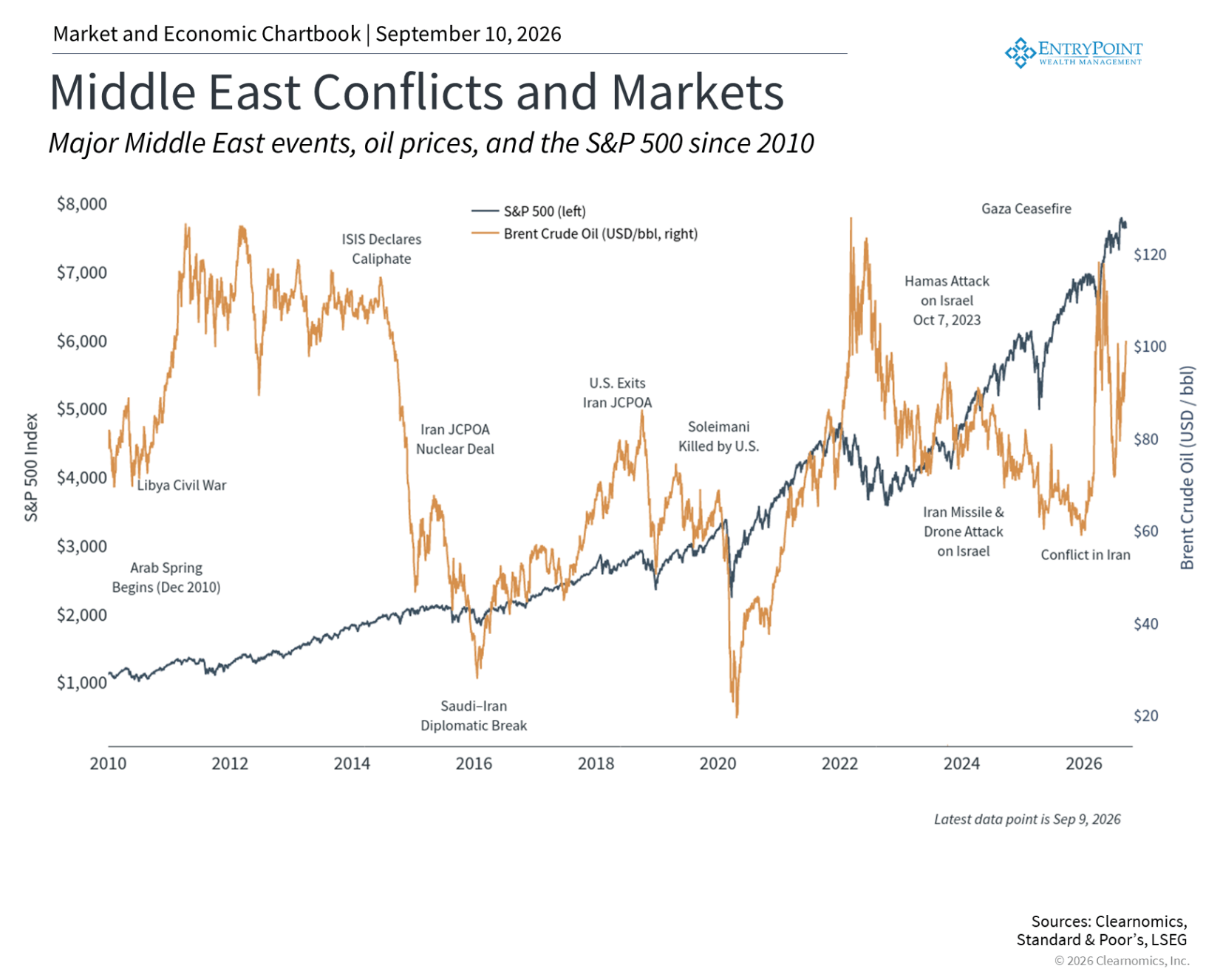
Middle East Conflicts and Markets
Major Middle East events, oil prices, and the S&P 500 since 2010
WHY ENERGY CAN HELP HEDGE INFLATION
Energy prices affect inflation directly through gasoline, diesel, heating, and electricity. They also work indirectly because transportation, manufacturing, agriculture, and distribution all require energy. When those input costs rise, businesses may pass part of the increase to consumers. [4]
That relationship is why energy exposure can be a useful inflation hedge. When higher oil and fuel prices are driving inflation, energy producers may benefit from the same price move that is raising costs elsewhere. In a diversified portfolio, those returns may help offset pressure on consumers, bonds, and businesses that cannot easily pass along higher expenses.
Today’s producer-price report reinforces the connection. Final demand energy prices rose 4.2% in August, including a 24.1% increase in diesel fuel. That helped push headline PPI up 0.4% for the month and 5.4% over the prior 12 months. [5]
Energy is not a perfect hedge. Oil and energy stocks can be volatile, and results also depend on production costs, capital discipline, regulation, geopolitics, and company execution. The case is not for an all-or-nothing bet. It is for measured exposure that may add diversification and resilience when energy costs are a major source of inflation.
COMMODITIES ARE BEST VIEWED IN A PORTFOLIO CONTEXT
For long-term investors, the focus should be on how energy behaves within a diversified portfolio rather than on predicting short-term oil prices.
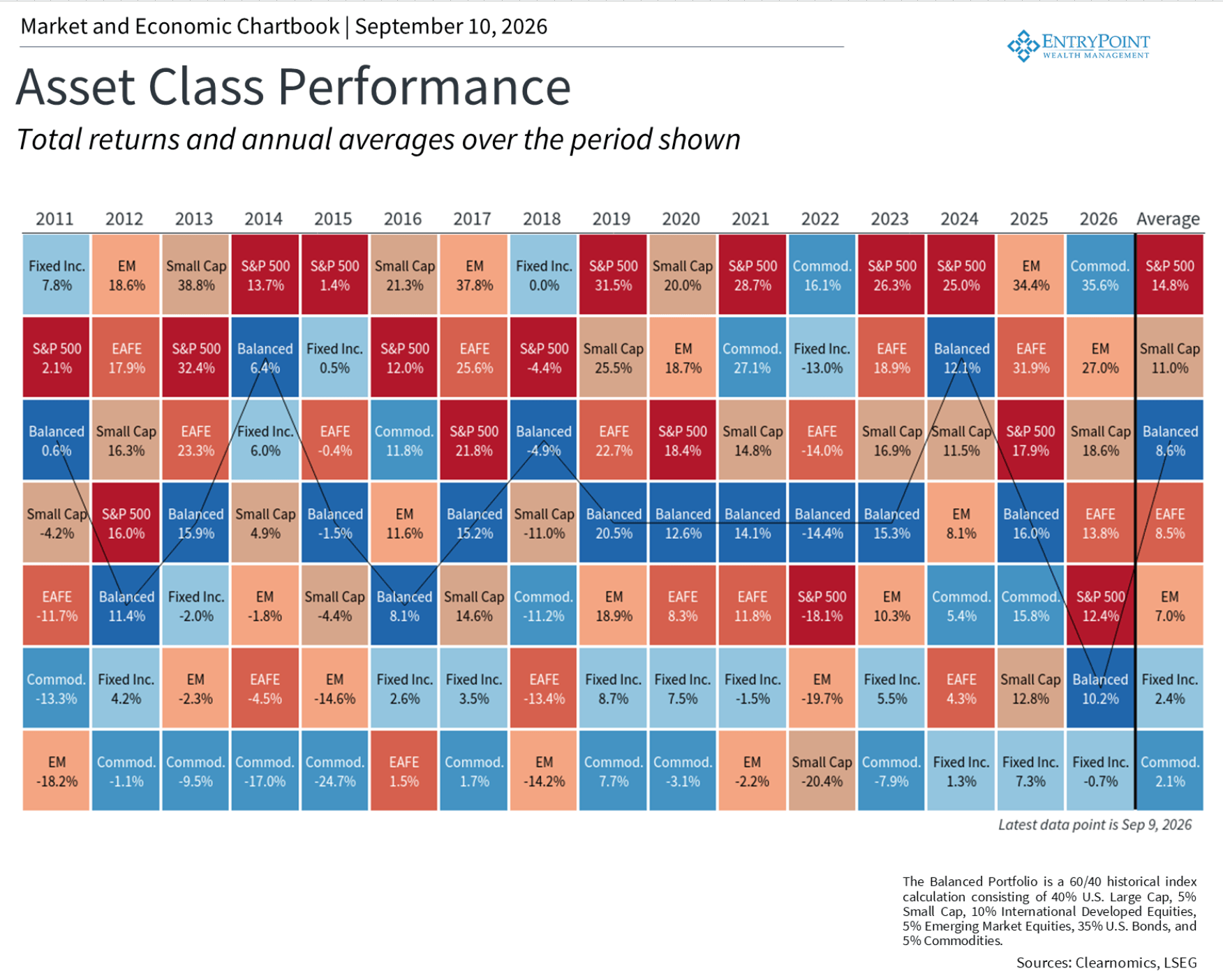
The Bloomberg Commodity Index has been the top-performing asset class so far this year, supported by high oil prices and broader supply-and-demand dynamics. Commodities can outperform in some years and lag in others, which is why energy exposure should be one component of a diversified allocation rather than a stand-alone strategy.
Other asset classes have also performed well, including emerging market stocks, small cap stocks, and U.S. stocks. Within the U.S. market, energy has benefited from higher oil prices. When energy is pushing inflation higher, owning energy-related assets can allow a portfolio to participate in that price pressure rather than only absorb the resulting costs.
A well-constructed portfolio can combine traditional stocks and bonds with an appropriately sized allocation to energy or broader real assets. The goal is not to predict every move in oil. It is to build a portfolio that can respond to different inflation and growth environments while managing commodity-related risk.
THE BOTTOM LINE
Energy prices are a meaningful source of inflation because they affect household expenses and the cost of producing and transporting goods. A measured energy allocation can serve as a practical hedge when oil and fuel prices rise, but it works best within a balanced portfolio designed for long-term financial success.
A CFP® professional can help you evaluate how energy, commodities, and other asset classes fit into your broader investment strategy—and whether your portfolio is positioned to weather different economic environments. At EntryPoint Wealth Management, we help clients build diversified portfolios designed around their goals, risk tolerance, and long-term financial plans. Reach out to me or schedule a strategy session to take the next step toward a more resilient financial future.
INDEX DESCRIPTIONS
S&P 500: The Standard & Poor’s 500 Index is a capitalization-weighted index of 500 stocks designed to measure performance of the broad domestic economy through changes in the aggregate market value of 500 stocks representing all major industries.
Bloomberg Commodity Index: The Bloomberg Commodity Index is a broadly diversified financial benchmark that tracks the price performance of futures contracts on physical commodities across multiple sectors.
REFERENCES
- https://gasprices.aaa.com/
- https://www.bls.gov/cpi/tables/relative-importance/home.htm
- https://www.eia.gov/dnav/pet/hist/leafhandler.ashx?n=pet&s=mcrfpus2&f=m
- https://www.federalreserve.gov/econres/notes/feds-notes/second-round-effects-of-oil-prices-on-inflation-in-the-advanced-foreign-economies-20231215.html
- https://www.bls.gov/news.release/ppi.nr0.htm

CHRIS WARD, CFP®
Chris has been helping clients as a Financial Advisor since 2007 and established EntryPoint Wealth Management as an opportunity to offer clients access to his best partnership for financial advice. He works as an integrated partner with you and your financial life, to help you better your financial situation and achieve your goals.
CONTACT CHRIS DIRECTLY: